
KRA is looking harder at digital money. Education News reported on 28 October that the tax authority is using M-Pesa records, including tills and paybills, to find income that was never declared, while noting that money passing through a wallet is not automatically taxable. Business Daily reported that KRA and Safaricom are discussing electronic tax invoices issued through M-Pesa for small traders. And since 1 January 2026, KRA has been checking income tax returns against eTIMS invoices, withholding tax and customs records.
None of this turns a welfare contribution into income. But it is one more reason an association’s money should never sit in a treasurer’s personal M-Pesa, where it mixes with their own and looks like their earnings. These five habits keep the books clean and the members’ trust intact.
1. An account in the association’s name, never a personal line
A registered association can get a paybill in its own name: Safaricom asks for a signed application form, a beneficial-ownership (UBO) declaration, a certified copy of the certificate of registration, a signed M-PESA authorisation form, the IDs of the officials and signatories, the organisation’s KRA PIN and bank details, and says it processes a complete application within 24 hours. Apply online through the M-PESA for Business portal (m-pesaforbusiness.co.ke). Paybills come with a choice of tariffs, so decide early whether the association or the member pays the charges.
For a one-off appeal by a group that is not registered, Safaricom’s Short-Term Paybill lasts up to six months and needs no business registration, but an ongoing association of ten or more people still has to register under the Societies Act. For a funeral, Safaricom asks for a burial permit, a death notification or a mortuary admission letter; for a fundraiser, a letter from the committee signed by at least two officials. Both also need the applicant’s ID and bank details. By default, the sender pays the charges.
2. A receipt for every member, every time
Every contribution gets a reply with the amount and the M-Pesa code, and goes on the list the same day. If a member asks “did you get my money?”, the answer is already in their messages.
3. Two people approve every payment out
The treasurer pays; the chair or a second signatory approves. Keep the receipt or M-Pesa code for every payment, with a line on what it was for.
4. A statement to members every month
Money in, money out, and the balance, in one short message. Present the full accounts at the AGM, as the Societies Act requires, and show the statement to any member who asks, with other people’s phone numbers hidden. Treasurers who publish rarely have to defend themselves.
5. Annual accounts on time
A registered society files an annual return with its accounts with the Registrar of Societies every year, by 31 March. Good monthly records make that a half-day job instead of a crisis.
When to ask a professional
Since July 2023 the Income Tax Act treats a body that carries on the activities of a members’ club as carrying on a business: its receipts, other than joining fees, subscriptions and welfare contributions, count as business income. So event tickets, sales or sponsorship may be taxable. Once the association has its own KRA PIN, ask KRA or a tax adviser which returns and eTIMS invoices apply to it. This guide is good practice, not tax advice.
Alumnipad keeps each member’s contributions with your member list, runs appeals with a target and progress members can see, and exports contributions to a spreadsheet for the committee and the AGM on paid plans. Plans start free for up to 50 members; see what each plan includes.
Start free on Alumnipad · Follow Alumnipad on WhatsApp
Share it
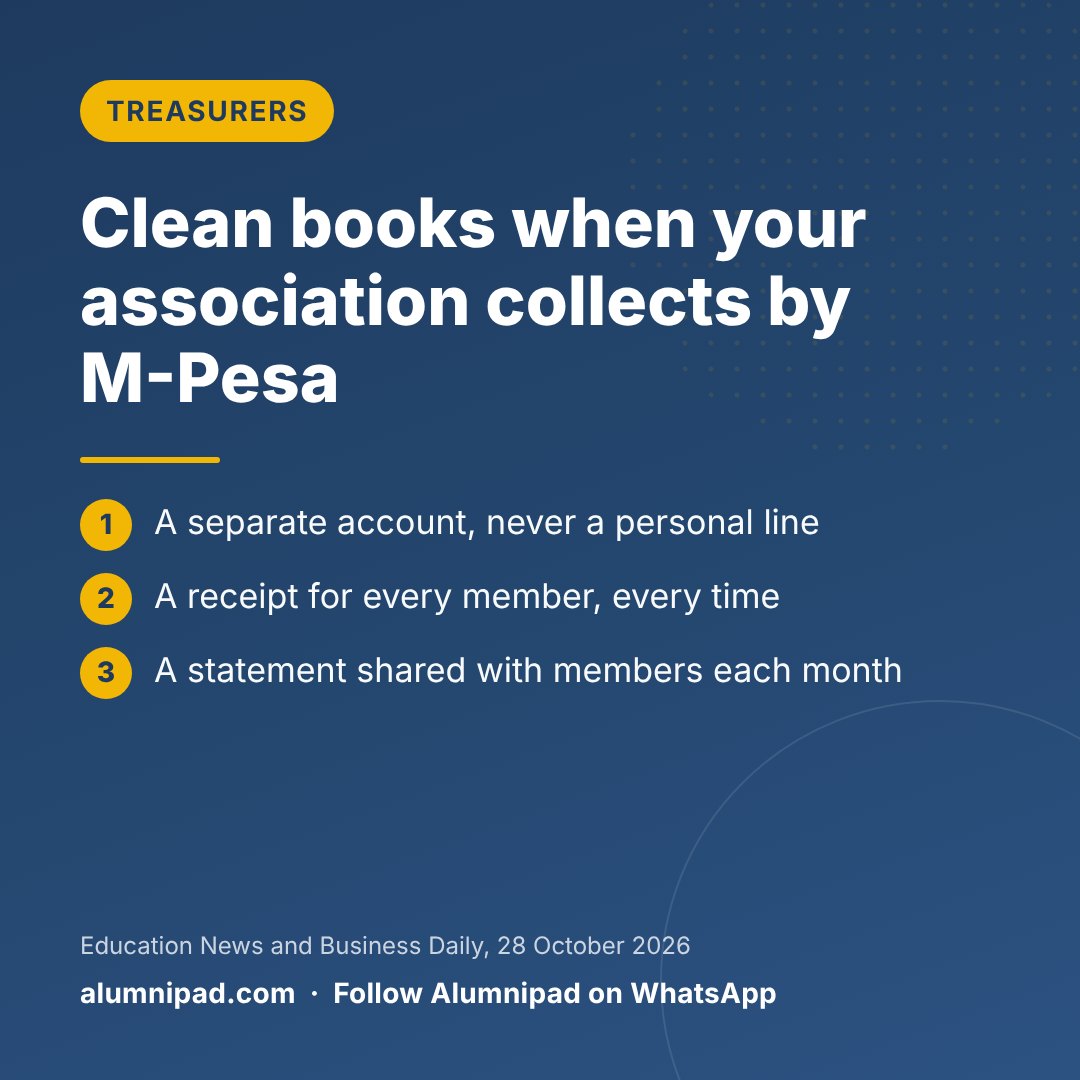
Download the square card or the 18-second video.
Sources: Education News, 28 October 2026; Business Daily, 28 October 2026; KRA public notice on validating income tax returns; Safaricom: M-PESA Paybill FAQs; Safaricom: Short-Term Paybill FAQs; Safaricom’s Lipa na M-PESA requirements (2024); Finance Act 2023, section 17; Societies Act.